Duration: October 2024 – September 2029
Role: Postdoctoral Researcher
Funding: FWF
Institution: Socio-Ecological Transformation Lab, JKU Linz
In the SETER project, led by Dr Stephan Pühringer, we are investigating how projects, discourses and practices relating to Socio-Ecological Transformation (SET) are permeated and shaped by Economic Reasoning (ER). In my work package on ‘Education’, we are analysing the extent to which Austrian economics and business administration degree programmes integrate issues of transformation – such as climate change, social justice or digitalisation – into their teaching and curricula, and, if so, exactly how.
Research output with my participation:
- Pühringer, Stephan; Bäuerle, Lukas (2026): The economics of socio-ecological transformations. A conceptual framework. In: Sustainability: Science, Practice and Policy 23(1). Online here.
Duration: January 2024 – January 2026
Role: PI
Institution: University of Hamburg and JKU Linz
This project marked the first time a team of researchers had examined a group of institutions operating under the umbrella term ‘New Economy Space’ (NES), which translates new economic knowledge into various social arenas. The case study of German NES think tanks focused on the inherent knowledge practices and the differences compared with established economic policy advice.
Research output with my participation:
- Bäuerle, Lukas; Maasen, Sabine (2026): Transforming Economic Knowledge from the Side Lane? The New Economy Space and its Think Tanks. In: Minerva (online first): 1–26. Online here.
- Bäuerle, Lukas; Reinke, Rouven (2026): Pluralising the economic knowledge of politics. Evidence from a German case study. In: New Political Economy (online first): 1–25. Online here.
Duration: August 2023 – December 2025
Role: PI
Funding: WiSo Faculty University of Hamburg
Institution: University of Hamburg and JKU Linz
In this project, we investigated how systemic inertia, competing sustainability narratives and imagined visions of the future are shaping the transformation of the German heating and housing sectors. We focused on interviews with practitioners involved in the heating transition during the ‘crucial phase’ of the GEG amendment process.
Research output with my participation:
- Semb, Josephine; Bäuerle, Lukas; Sagvosdkin, Valentin (2026): System-Induced Transition Inertia in the Transformation of the German Heating and Housing Sector. In: Energy Policy 212: 115181. Online here.
- Sagvosdkin, Valentin; Bäuerle, Lukas; Semb, Josephine; Praetorius, Barbara (2026): To Build or Not to Build? Sustainability Narratives between Growth-Oriented “Eco-Markets” and Regulative “Sufficiency” in Germany’s Heat Transition. In: Energy Research & Social Science 131: 104527. Online here.
- Bäuerle, Lukas; Barkey, Merle; Sagvosdkin, Valentin; Semb, Josephine (2026): “We need long-term thinking, predictability, and reliability.” Imagined futures of the German heating and housing transition. In: Futures 175: 103736. Online here.
Transfer:
- 23.02.2026: Wärmewende abseits der Schlagzeilen: Wie sie von betroffenen Unternehmen und Verbänden gesehen und bewertet wird. KOMPASS Public Brief 2026-2. Link.
Duration: March 2021 – June 2022
Role: Co-PI
Funding: Volkswagen Foundation
Institution: Hochschule für Gesellschaftsgestaltung
In the “New Imaginative Economies” research project, we used a sensemaking approach (SenseMaker®) to investigate whether and how spontaneous entrepreneurial behaviour during the Covid-19 pandemic led to social innovations and how this can contribute to lasting change, for example in the way agents imagine the future and deal with radical uncertainty.
Research output with my participation:
- Hector, Veronica; Schlaile, Michael; Bäuerle, Lukas; Friedrich, Jonathan; Peters, Luis; Hilt, Annette; Zscheischler, Jana; Graupe, Silja (2026): Innovation Amidst Turmoil, part 2: Narratives and Sensemaking among German Managers during the pandemic. In: Journal of Innovation Economics and Management (online first). Online here.
- Schlaile, Michael; Hector, Veronica; Peters, Luis; Bäuerle, Lukas; Smith, Beth; Hilt, Annette; Graupe, Silja (2024): Innovation Amidst Turmoil: A SenseMaker Study of Managerial Responses to the COVID-19 Crisis in Germany. In: Journal of Innovation Economics and Management 43(1): 285–318. Online here.
- Bäuerle, Lukas; Graupe, Silja (2023): Reframing economic agency in times of uncertainty. In: International Journal of Pluralism and Economics Education 14(1): 31–46. Online here.
Duration: January 2017 – December 2018
Role: Researcher
Funding: Forschungsinstitut für gesellschaftliche Weiterentwicklung Düsseldorf
Institution: Hochschule für Gesellschaftsgestaltung
In the context of the ongoing debate on the need for reform of economic education, the project focused on the students’ perspective. In cooperation with a team from the Goethe University in Frankfurt, a mixed-methods survey was conducted to investigate student orientations and ways of dealing with economics programs in Germany and Austria.
Research output with my participation:
- Bäuerle, Lukas; Pühringer, Stephan; Ötsch, Walter Otto (2020): Wirtschaft(lich) studieren. Erfahrungsräume von Studierenden der Wirtschaftswissenschaften. Wiesbaden: Springer VS. Online here.
- Bäuerle, Lukas (2020): Ökonomisierte ökonomische Bildung. Zur Dominanz struktureller Bedingungen wirtschaftswissenschaftlicher Studiengänge. In: Fridrich, Christian; Hedtke, Reinhold; Ötsch, Walter Otto (Eds.): Grenzen überschreiten, Pluralismus wagen. Perspektiven sozioökonomischer Hochschullehre (Sozioökonomische Bildung und Wissenschaft 3). Wiesbaden: Springer VS. Online here.
- Pühringer, Stephan; Bäuerle, Lukas (2019): What economics education is missing: the real world. In: International Journal of Social Economics 46(8): 977–991. Online here.
- Bäuerle, Lukas; Pühringer, Stephan; Ötsch, Walter Otto (2019): “Ohne Effizienz geht es nicht.” Ergebnisse einer qualitativ-empirischen Erhebung unter Studierenden der Volkswirtschaftslehre. In: van Treeck, Till; Urban, Janina (Eds.): FGW-Studien Neues ökonomisches Denken 13. Düsseldorf: FGW. Online here.
- Pühringer, Stephan; Bäuerle, Lukas; Engartner, Tim (2017): Was denken (zukünftige) ÖkonomInnen? Einblicke in die politische und gesellschaftliche Wirkmächtigkeit ökonomischen Denkens. In: Gesellschaft, Wirtschaft, Politik 66(4): 547–556. Online here.
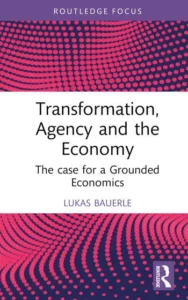
Bäuerle, Lukas (2023): Transformation, Agency, and the Economy. The Case for a Grounded Economics (Economics and the Humanities). London; New York: Routledge. Online here.
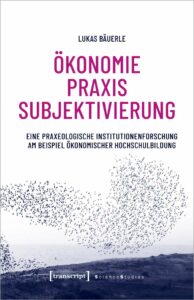
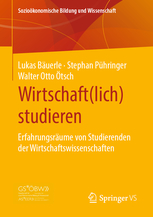
Bäuerle, Lukas; Pühringer, Stephan; Ötsch, Walter Otto (2020): Wirtschaft(lich) studieren. Erfahrungsräume von Studierenden der Wirtschaftswissenschaften. Wiesbaden: Springer VS. Online here.
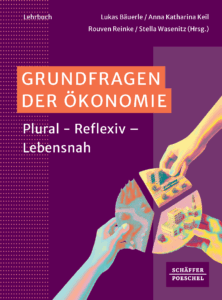
Bäuerle, Lukas; Keil, Anna Katharina; Reinke, Rouven; Wasenitz, Stella (2026): Grundfragen der Ökonomie. Plural — Reflexiv — Lebensnah. Stuttgart: Schäffer-Poeschel. Online here.
Fridrich, Christian; Hedtke, Reinhold; Bäuerle, Lukas; Hantke, Harald; Mauri, Ursula; Milz, Sandra (Eds.) (forthcoming 2026): Let’s test the tests! Fachwissenschaftliche Analysen von Wirtschaftswissenstests. Wiesbaden: Springer VS.
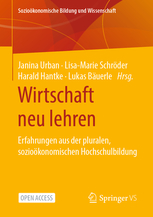 Urban, Janina; Schröder, Lisa-Marie; Hantke, Harald; Bäuerle, Lukas (Eds.) (2021): Wirtschaft neu lehren. Erfahrungen aus der pluralen sozioökonomischen Hochschulbildung. Wiesbaden: Springer VS. Online here.


